Removing the bottlenecks to scalable hydrogen production
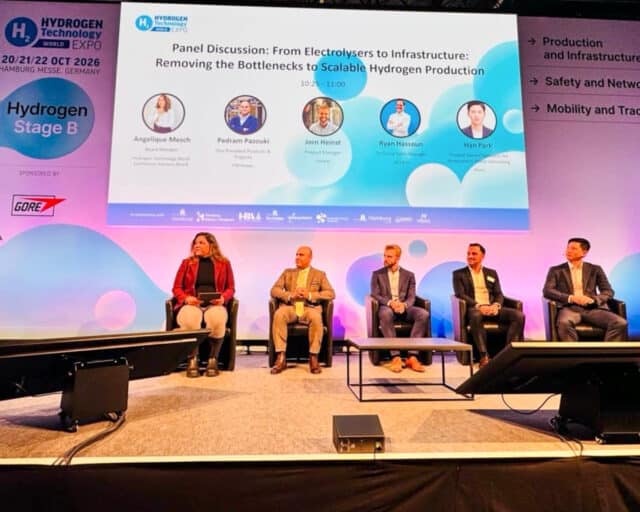
At Hydrogen Technology World Expo in Hamburg, Jorn Heinst, Technical Product Manager at HyGear, took part in the panel discussion “From Electrolysers to Infrastructure: Removing the Bottlenecks to Scalable Hydrogen Production”.
His message was practical. Renewable electricity is often expensive and hard to get, and this holds back the growth of green hydrogen production. Electrolysis will play a central role in the hydrogen economy. But if the industry relies only on renewable electricity, it faces problems with cost, availability and grid capacity. Other technologies can help solve these problems and build a more flexible hydrogen supply faster.
This article summarises his view. It also describes two routes HyGear sees today. Both reduce dependence on renewable electricity and support a low-carbon hydrogen economy.
The electricity bottleneck holding back green hydrogen
Electricity is one of the main costs of producing green hydrogen through electrolysis. In many markets, affordable, reliable renewable electricity remains hard to access. Renewable sources do not generate power all the time. Electricity prices can rise and fall sharply. And large electrolysers often have to wait years for a grid connection.
As a result, green hydrogen is expensive, and project economics are uncertain. Even when renewable electricity has a competitive price, electrolysers may not run at full capacity. Limited grid capacity can prevent this. So can a mismatch between the hours when renewable sources generate power and the hours when industry needs hydrogen.
To solve this, the industry needs more than extra electrolysis capacity. It must also look at other technologies. These technologies use less electricity, make better use of available resources, and offer other routes to low-carbon hydrogen.
Reducing dependence on renewable electricity
The practical question is this: how can the industry produce more low-carbon hydrogen faster, without relying only on cheap and plentiful renewable electricity?
HyGear sees two routes that can help today.
Route 1: Hydrogen recycling with Hy.REC®
When every kilogram of hydrogen is expensive, the cheapest hydrogen is often the hydrogen you already have.
In several industrial processes, hydrogen leaves the process in off-gas streams. Companies often vent this gas or leave it unused. If you recover, clean, and reuse that hydrogen, you need to produce or buy less fresh hydrogen.
HyGear’s Hy.REC® process gas recovery system does exactly this. It works with protective atmospheres, such as the mixtures of hydrogen and nitrogen in float glass production. It also works with process gases that contain hydrogen in metallurgical applications, such as reduction furnaces.
Depending on the application and set-up, Hy.REC® can handle gas flows of up to 1,000 Nm³/h. It recovers at least 99% of the gas and sends it back to the process, cleaned and treated.

How recycling helps overcome the electricity bottleneck
Recycling does not reduce the electricity that electrolysis needs per kilogram of hydrogen. Instead, it reduces the amount of new hydrogen you need to produce in the first place.
When industrial users recover and reuse hydrogen that they would otherwise lose, they depend less on external hydrogen supply. They also need less new production capacity, including electrolyser capacity, for the same hydrogen consumption.
In this way, recycling makes better use of the hydrogen that is already available. It also reduces the pressure on new production capacity.
Route 2: Hydrogen and syngas from biogas as a bridge
The second route uses biogas. This renewable feedstock depends less on renewable electricity.
For some applications, you can upgrade biogas to biomethane and then reform it into hydrogen. This may offer a lower-emission alternative to hydrogen from fossil sources. Unlike electrolysis, this route does not need large amounts of renewable electricity. The conversion process still uses energy, however.
You can also convert biogas into syngas. Syngas is a mixture of mainly hydrogen and carbon monoxide. Industry uses it as an important intermediate product for methanol and synthetic fuels. For these applications, turning biogas into syngas can be a practical alternative. The other option is to produce hydrogen through electrolysis and source carbon separately.
When biomethane conversion makes sense
Biomethane is a valuable renewable resource in its own right. You can inject it into the natural gas grid or use it directly as a fuel. Converting it into hydrogen or syngas only makes sense when this creates more value than direct use.
The economic and environmental benefits depend on several factors: the application, the origin of the feedstock, local energy prices, the energy the process needs, and the economics of the whole system. That is why each case needs its own assessment.
A technology-neutral hydrogen transition
The conclusion from Hamburg: no single technology will remove all the bottlenecks in the hydrogen economy. HyGear supports a technology-neutral approach. This means choosing the technology that fits each specific application:
- Electrolysis, where affordable renewable electricity and a viable business case exist.
- Hydrogen recovery and recycling, wherever industrial processes currently lose hydrogen.
- Hydrogen or syngas from biogas and biomethane, where the application and the overall economics justify it.
- Other low-emission technologies, after a fair assessment for each application.
Scaling the hydrogen economy takes more than extra electrolyser capacity. When the industry combines electrolysis with hydrogen recovery, alternative feedstocks and other technologies, it depends less on renewable electricity. It can also build a more resilient and economically viable hydrogen supply faster.
The goal is to use available energy and resources as efficiently as possible, so the industry can produce low-carbon hydrogen at scale. Producing more hydrogen through electrolysis is not the goal in itself.